- Collect itEverything, on one file.
- Sign itInto the document itself.
- Prove itTwo factor, then a face match.
- Keep itWritten once. Never edited.
Every document becomes evidence.
One platform that does three things completely. It collects your documents, it signs them, and it manages the contracts they become. Built for law firms, brokerages and immigration practices, for anyone who collects sensitive documents for a living.
Plate IThe document read, not photographed
The government document is read edge to edge, front and back, and the machine-readable zone is checked against the printed page.
Watch a file close, end to end.
The whole service in one run: a request going out, a signer proving who they are, a document signed inside the file rather than beside it, and the ledger that holds it all afterwards. No slides, and nothing sped up to hide a step.
- Where the request starts and what the other side actually sees
- The identity check, taken live, in the moment of signing
- What the ledger keeps, and why it is the part that matters later
Please press play to watch the video and see how the product works.Thank you.
A folder is not evidence.
Every regulated file starts the same way. You need documents from someone. You need to know they are who they say they are. And you need it to hold up later.
You email. You chase.
A photograph of a passport taken at an angle. A form filled in wrong. A signature pasted in from another document.
Two years pass.
Someone asks you to prove what happened, and what you have is a folder of attachments and a memory of the sequence.
The record has to speak for itself.
Who was asked, who opened it, how they proved who they were, what they sent, who approved it, and when.
Collect, sign, and keep, without changing systems.
Most tools send a document out. Trust Ledger also brings everything in: uploads, forms, completed PDFs and signatures, through one door, on one file, in one sequence.
Eleven emails become one link.
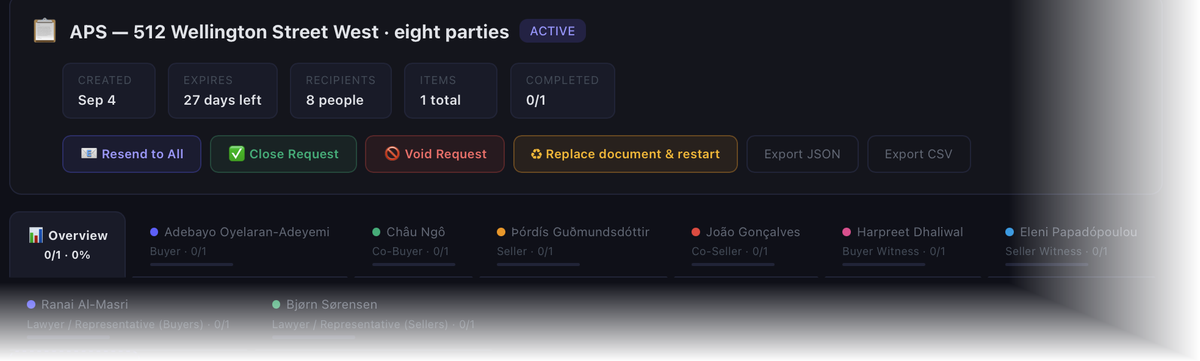
Not one document sent to one person. One file, with everyone on it: the applicant, the co-applicant, the guarantor, the witness, the notary, if the matter needs them. Starting one takes about a minute.
- Name the request, add your people, and say what you need to know about each of them
- Each person gets their own link, their own list, and their own turn
- The co-applicant cannot see the applicant's bank statement. The witness cannot see either
- The order you set is the order that happens. The second signer does not become the first because they opened their email sooner
Nothing completes because a client pressed submit.
Everything comes back to one screen, where you approve it or send it back with a note. Send one item back and only that item reopens. Everything they already gave you stays. They correct one field, they do not start again.
- When a document itself has to change, that is a new round of the same file, not a new file
- The earlier round, with its signatures and its dates, stays exactly where it is
- A signed instrument cannot be quietly edited, deleted, or sent back. It can only be superseded, on the record
Before anyone touches a legal instrument, we establish who they are.
A one-time code to the number on file. Then biometric identity verification: their government photo ID, captured and read, and a live face match against it. Not a photograph of a photograph. A person, present, matched to their document.
- Consent is asked for properly and recorded against the jurisdiction the client is in, because the rules in Quebec are not the rules in Texas
- The biometric data itself is not retained. The verification is the record, not the face
- The result travels with the file. Not in an email. On the signature
Ask the client once. Not once per matter. Once.
Closing a file does one more thing. Everything you collected becomes part of that client's profile, under the name of the fact, not the name of the form. The next matter, on a different template, opens already knowing their date of birth.
- When something changes, you see that it changed, when, and what it was before
- Carry-forward works across templates, because the facts are stored as facts
Signing is where most platforms stop. It is where the obligation starts.
Trust Ledger reads what you have signed and tells you what it commits you to. Obligations, with dates. Renewals, before they renew themselves. Exposure across the whole portfolio, not one agreement at a time.
- Ask a question in your own words and it answers from your own contracts, and cites them
- Every answer points at the clause it came from, so you can check it. An answer you cannot check is an opinion
- Draft against your playbook, redline against your standard position, route for approval by the people actually allowed to give it
“That isn't my signature. I never signed anything.”You don't argue. You open the record.
The signed document. The identity verified behind it. The timestamps, the hash, every step of the trail. And under every mark, a fingerprint of its origin: the IP address, the device, the operating system, browser or native app, captured at the moment of signing and for every action on the platform.
Not just signed. Who. Where. On what. Provable, and ready for the auditor, the regulator, or the court.
Inside the ledger →See your first file close, end to end.
Book a twenty-minute walkthrough. We will run a real request from creation to signed record, including identity verification, and you can ask what happens when it is challenged.